Wednesday, February 8, 2012

Hong Kong Orchid Tree Not an Orchid at All

By Lee Potts
Orchid Specialist

The Hong Kong Orchid tree impresses The Garden’s visitors year round with its incredible canopy that stretches over 30 feet wide and features delicate branches that drape over the walkways with six-inch, heart-shaped leaves. As beautiful as this canopy is, it’s during the winter that this tree becomes even more impressive — by producing an almost endless supply of magenta-purple flowers nearly as big as your hand for up to five months.

Although orchid has become an established fixture in this tree’s common name — and is a reference to the flowers’ resemblance to other orchids — The Hong Kong Orchid tree is actually a closer relative to the common garden pea.

The Hong Kong Orchid tree, botanically known as Bauhinia blakeana, is considered to be a natural species since it is sterile. Until a recent discovery of a lone tree in Hong Kong, it was believed that
none of these trees produced seed. Because of this, it is possible that all Hong Kong Orchid trees originated from one single tree cultivated by the Hong Kong Botanical Gardens in the late 1800s.

Although it is still debated today, Bauhinia variegata and Bauhinia purpurea are commonly thought to be the species that produced Bauhinia blakeana, which was discovered in 1880 by a French priest on the shore of Hong Kong Island near Pok Fu Lam. Many reports lead us to believe that this discovery was of a single Bauhinia blakeana which is the only one discovered in the wild. In 1908, the first scientific description was made by S.T. Dunn, superintendent of the Botanical and Forestry Department of Hong Kong, who assigned this tree to the genus Bauhinia and named it after Sir Henry Blake, British Governor of Hong Kong from 1898 to 1903.

By 1914 the Bauhinia blakeana was being introduced outside of The Hong Kong Botanical Gardens on a wider scale. It is often recognized from its image that appears on the Hong Kong flag and coins. In addition, a statue of this plant is on display in Golden Bauhinia Square in Hong Kong. With the beauty of the year round foliage and winter purple magenta flower, we consider this tree to be a highly valued tropical treasure.

Monday, August 15, 2011

Low Maintenance Doesn’t Mean No Variety

Colorful tropical plants add beauty and create a relaxing atmosphere to any interior living environment whether at home or work. Maintaining tropical plants inside may seem to be challenging, but luckily there are many that are low maintenance. Three favorites come to mind:

The first is Sansevieria, commonly known as the snake plant. With very low water and light requirements, this is one of the easiest plants to maintain. There are several cultivars that range in size from six inches to around three feet. Colors range from dark green foliage to white with some cultivars having very intriguing combinations of both.

Consider using Sanseverias in containers along with the next plant on my list of favorite tropicals, Codiaenum variegatum, commonly known as the croton plant. There are hundreds of cultivars available, and my description cannot do this tropical treasure justice. Its bright patterned foliage includes an absolutely indescribable combination of green, yellow and red, with multiple leaf patterns and a variety of sizes. Crotons do well in indirect light and perform better if they are allowed to dry out between watering.

A third addition to this tropical container combination is bromeliads—specifically, the terrestrial Guzmanias or Neoregelias. The color range is wide open in this group of tropical plants, and their maintenance requirements are simple. Bromeliads can live without water for long periods of time, provided water is maintained in a naturally occurring cupped area located in the center of the plant. Keeping water in the “cupped” area will keep this tropical hydrated. Add fresh water once weekly to avoid the water becoming stagnant. Bromeliads, either alone or grouped in a container, will add remarkable beauty to any surrounding while not demanding a lot of maintenance.

Friday, April 29, 2011

Whoooo's Using Box #18?

The bluebird season is well on its way with numerous chicks ready to fly, if they haven't already by now. A few of the nestboxes have been claimed by chickadees, titmice and, in one box, a tree swallow claimed the same one it used last year. When we peeked in the box, a Canada goose feather wafted out and the swallow chased it down and returned it to its proper place. It didn't like our disturbing the decorating scheme.

One box, in particular, has been a big disappointment this year. We are in the fourth year of the monitoring project, and Box #18 has been the most successful in producing little blues. We believe its location near open areas and a few lampposts for perching places contribute to its success. However early in the season, we found feathers (perhaps a mourning dove) at the base of the support pole. There has been no bluebird activity nearby at all. No blues watching us or singing their lilting calls from the trees. Recently, we found owl pellets around the pole so we're sure the box is doomed and an owl is using it as a hunting base. We're going to relocate that box and hope the bluebirds will take an interest again.

This is the first year that we've had nests with six eggs in them and, in fact, there are two boxes with half-dozens in there. If they all hatch, those parents are going to be very busy catching meals for hungry chicks.

Also this year, we've noted a pair of wood ducks hanging around the duck box on the larger of the two ponds. Although bluebirds are our main responsibility, we do keep a watchful eye for all the birds and always have our binoculars in ready-mode. Seeing the wood ducks near the nestbox was exciting and we hope they have decided to use it. At this point we haven't checked the box for fear of spooking the ducks.

As in past years, some nests have been disturbed and the eggs disappeared. In one case, it was a house wren. Those birds are notorious for destroying bluebird nests and tossing the eggs out of the box. Then they go in and build their stick nests on top of the bluebirds' nests and take over. We also believe that snakes have gotten into at least one box. However, it's all part of nature and we keep that in mind.

So at this point, the season already has had a few surprises and we're always interested in whatever we find when we ride the trail. There's still lots of activity to come.

Tuesday, February 1, 2011

The Evolution of the Cattleya

By Lee Potts
DSBG Orchid Specialist

The
Cattleya species has come a long way since being discovered by William Swainson in 1818. It soon became sought after for the large lavender flowers but had yet to be successfully grown and bloomed outside its native habitat. In an effort to try and grow the Cattleya outside of its habitat, Swainson shipped the Cattleya labiata orchids to English horticulturist William Cattley from Brazil in 1818.

At one point during the 1800s
Cattleya labiata was thought to be nearing extinction in the wild due to Swainson's poor record keeping and in part to coffee farmers clearing land in Rio de Janeiro. It took 71 years before these orchids were rediscovered in Pernambuco, Brazil, but this was the beginning of an era that would change the landscape of orchids.

Cattleyas became known for their use in corsages but were only affordable to the very wealthy until Cattleya 'Bow Bells', registered in 1945, opened the doors for mass production of large, white Cattleya cut flowers. Through improvements in cross pollination, these cut flowers dominated the commercial sale of Cattleyas until the 1980s when orchid hybridizers improved tissue culture methods.

While still widely known as an orchid commonly used for corsages, the
Cattleya would soon be known for the endless variety of sizes and colors they offer. Horticulturists and botanists have not only prevented the extinction of a number of Cattleya species, but also, through hybridization and tissue culture made it possible for all of us to enjoy the wide variety of colors, sizes and fragrance available today in the Cattleya alliance and earning the title Queen of Orchids.

Friday, January 7, 2011

Winter Gardening with Kaiti O'Donnell - DSBG Lead Horticulturist

A winter garden is much more than just the silhouettes of bare branched, deciduous trees against the gray winter sky, and more than the shrubs whose flowers have long since turned to berries. A winter garden is more than just the scent of evergreen conifers that hint at the holiday season to come.

In addition to the outline of branches against a chilly winter backdrop, berries and textural bark – take note of a few plants worthy of mention that provide bloom as well as fragrance in the winter landscape.

Take for example Edgeworthia chrysantha, also known as rice paper plant that is featured in the Four Seasons garden. Not only will the unusual flowers entice you into taking a closer look, but the fragrance will surely make you look forward to each future winter come. What’s more, this unique shrub stays in bloom for several weeks!

Another winter blooming plant worth mentioning is Jasminum nudiflorum-an interesting shrub that provides a characteristic mound of arching green branches throughout the year followed by a vibrant, long lasting display of fragrant yellow blossoms in January.

Lonicera fragrantissima, a non invasive honeysuckle,(unlike it’s vine cousin),- produces a fragrance so notably sweet that it is to die for .

Camelia sasanqua and C. japonica have countless cultivated varieties, too many to name, - in fact, but these lovely broad-leaf evergreens provide a long season of interest-with the earliest varieties setting bud and often blooming as early as October. Others show flowers in middle to late winter, while others bloom through the early parts of spring. Fragrances range from sweet to spicy, and colors include a wide array of pinks and reds, white and rarely, but occasionally yellow. Flower shapes are many and include single, double, rose and peony forms. Because of their year round interest, robust nature and all around versatility- Camellias are a must have for any southern garden.

In years when winter weather is mild – Winter Daphne will perform true to its name generally showing blooms in February and exuding a wonderfully sweet fragrance.

For the tail end of winter into early spring note the Winter Hazel which may provide late winter to early spring interest with its fringy and fragrant blooms.

Early flowering spring bulbs such as Glory of the Snow, Snowdrops, species Crocus and even some daffodil varieties such as February Gold will often surprise you by emerging from the ground in late winter months .

Thus, the possibilities for winter blooming plants are more vast than you think and some of the season’s finest examples can be seen throughout the Garden .

Wednesday, November 17, 2010

Calling all Shutterbugs!

As we end 2009 with a wonderful year of events, exhibits and amazing members and guests, it's nice to recap it all with our annual photography contest, Shutterbug! The contest deadline is Dec. 31 and it's just enough time to take pictures of Holiday Lights. It is so exciting to get an envelope marked Shutterbug entry and to open to see what magical moment was captured here at the Garden. We have 7 categories: Plants, Wildlife, Water, Architecture & Artwork in the Garden, Orchids & Tropical Plants, Events/Celebrations and People. Contestants may enter one photo in each of the categories if they like. Another exciting aspect of this contest is that we have an adult amateur and youth amateur category. To see some of the youth entries and then look at their age is incredible to think being that young and taking such a great shot. I remember using the Kodak disposables as a kid and that was either a hit or miss...most of the time for me a complete miss! The picture that accompanies this blog was taken by one of our youth contestants, Stephanie Aliano, and won 1st place in our Youth/Wildlife category. I think I'll be signing up for one of the many photography classes we offer here at the Garden to see how it's done. Good luck to all of our 2010 Shutterbug contestants and if you would like further details just visit www.DSBG.org.

Tuesday, November 9, 2010

600,000 Holiday Lights...anyone want to assist with putting them up?


At the beginning of October we usually start planning what we're going to dress up as for Halloween, start buying Halloween decorations...here at the Garden, we start preparing for Christmas! In saying that it may sound like visiting a store and having Christmas decorations being put out on the shelves when Halloween hasn't even passed yet...but with 600,000 lights it takes us pretty much the whole time until Holiday Lights opens the day after Thanksgiving!

If we actually were to lay those 600,000 lights out they would reach from the Garden to Concord Mills Mall! Here are some additional behind the scenes facts for Holiday Lights at the Garden:

  • It will take about 2,500 man hours to complete the installation.
  • The Orchid Tree inside the Visitor Pavilion is composed of 300 live orchids on a frame that makes the tree 16 feet tall.
  • We use about 2,000 drop cords to run lights from existing power supplies.
  • Schneider Tree Care will assist us with hanging 50 ornaments, 2-3 feet in diameter, in a tree as high as 75 feet. (Thank you Schneider Tree Care!)
  • About 540,000 of the lights we use are LED lights which burn cooler and used 90% less electricity.
And the great thing about it, we absolutely love doing it and putting on a spectacular light display for all of our guests, and to create some wonderful holiday memories with family and friends! We'll have live entertainment and visits from Santa! For an additional fee we'll have baked treats, hot cocoa, coffee at our Garden Coffee Shop by Caravan coffee and carriage rides from Southern Breezes Carriages. Be sure to check our event calendar on the Garden's website at www.DSBG.org to see who will be performing the night you are looking to attend.

It is a wonderful time of the year and we look forward to having all of our Garden guests come and see our lights display!
Holiday Lights at the Garden is sponsored by CaroMont Health and Lite 102.9.

Monday, October 25, 2010

Hank's Pumpkin Soup Recipe


Our director of horticulture is sharing his pumpkin soup recipe with us this Halloween! Pumpkins are one of our favorite Halloween decorations and also makes some great pies...if you've never had pumpkin soup give this simple and delicious recipe a try brought to you by Hank Bruno, DSBG Director of Horticulture.

Hank's Pumpkin Soup Recipe

8 cups chopped fresh pumpkin (about 3 pounds)
4 cups chicken broth
3 small tart apples, peeled and chopped
1 medium onion, chopped
2 tablespoons lemon juice
2 teaspoons minced fresh gingerroot
2 garlic cloves, minced
1/2 teaspoon of salt

Toasted Pumpkin Seeds:
1/2 cup fresh pumpkin seeds
1 teaspoon canola oil
1/8 teaspoon salt

Directions
In a 5 quart slow cooker, combine the first eight ingredients. Cover and cook on low for for 8-10 hours or unitl pumpkin and apples are tender. Meanwhile, toss pumpkin seeds with oil and salt. Spread onto an ungreased 15-in. x 1-in. baking pan. Bake at 250 degrees for 40-45 minutes or until golden brown. Set aside. Cool soup lightly; process in batches in a blender. Transfer to a large saucepan; heat through. Garnish with toasted pumpkin seeds.

Yield: 9 servings (about 2 quarts)


Monday, October 18, 2010

New Fall Family-Friendly Event, Bootanical


We are going to kick off a new family-fun event at the Garden, Bootanical on Oct. 30 and 31 from 9 a.m. to 3 p.m.

Many of the familiar sights of Halloween include pumpkins, scarecrows, and spiders which are based in nature, and form the basis for this fun new daytime event. Families will get a chance to work together to stuff and hang a scarecrow, pot up a spider plant, and mix up a batch of their own unique “bootanical” potion using dried herbs, and take a tour through the Garden in all its autumn brilliance. We have special autumn-themed photo vignettes that feature pumpkins and hay bales which make for a perfect fall family picture.

We encourage children to come dressed in their favorite costume and if they do they will receive a 50% discount with a paying adult.

Bootanical, part of a the Garden’s Fall with a Fourish celebration, is free with Garden admission. Carriage rides will be available for an additional fee through Southern Breezes, weather permitting. Snacks and drinks will be available for purchase from Karen Warren Catering. To see a menu for Bootanical just visit our event listing at www.DSBG.org.

Members are free, $12 adults, $11 seniors 60+, and $6 children 4-12. The Garden is open 9 a.m.-5 p.m., seven days a week. For more information call (704) 825-4490 or log on to www.DSBG.org.

Thursday, September 2, 2010

Something's A-Flutter returns to the Garden

Something's A-Flutter opened at the Garden yesterday and continues until Sept. 30. We kicked off the event with children from Presbyterian Hemby Children's Hospital to serve as grand opening opening ambassadors and release live butterflies the day before opening. This event is always a guest favorite and I have to say is for me as well! This was the first exhibit I worked on at the Garden and found myself everyday of the exhibit wanting to head down to The Orchid Conservatory to spend some time with my new fluttery friends!

This year's exhibit features a couple of new things. Every Friday and Saturday of the event there will be a butterfly activity station offered from 11 a.m. - 3 p.m. We also have a Caterpillar Crib set up outside The Orchid Conservatory where guests can see the larval stage of butterflies, commonly called caterpillars. The Caterpillar Crib will also feature host plants for caterpillars, different from the food source for an adult butterfly. The Orchid Conservatory still serves as the main part of the exhibit, but the entire Garden has incorporated interpretative panels and butterfly plant labels that make up the Butterfly Trail.

In addition to the new features the Garden will also have a class every Friday and Saturday from 1-2:30 p.m. of the event titled, Butterflies "Behind the Scenes". Guests can learn about their general care and maintenance from the moment they arrive at the Garden till the time they are released. Guests can also participate in mounting chry
salis' and releasing butterflies in the Conservatory. The cost is $18 for members and $22 for non-members.

Don't forget to bring your camera for some great photographs and to wear bright colors to the exhibit so maybe a butterfly will land on you, just like this picture from one of our grand opening ambassadors!


Friday, August 27, 2010

A Seasonal Ending

The Eastern Bluebirds have finished their nesting season here at the garden. Some of the juveniles continue to fly to the boxes where they began life. That's normal. One wonders if they like to check out the old homeplace just like people do, but we have to be careful not to anthropomorphize - apply human characteristics to animal behavior.

At the beginning of the season we tried something new, hoping to encourage the birds to use more of the boxes. We placed inserts made from egg cartons inside on the bottom of each box. Out of the thirty-three boxes on the trail, twenty-nine boxes had bluebird nests in them. This is an eight percent increase of box use over last year's activity. However, numbers don't always tell the whole story so we aren't going out on a limb to recommend using inserts. Bluebirds, like many other birds, often build nests and never use them. There were many perfectly made nests that never had eggs laid in them. Also, there were many eggs laid this year that never hatched. The parents just seemed to have abandoned those nests. It could be that the extremely high summer temperatures caused the eggs to fail to develop. In all cases, the eggs had discolored and we removed them along with the nests.

However, there was an increase in the number of birds that fledged. This year seventy-one fledged. That's a slight increase over the previous year when sixty-seven new "blues" graced the garden. Again, there were predators that invaded the nests, probably snakes and raccoons. One box was attacked by fire ants. These things are disturbing but, at the same time, nature has its own way of keeping life balanced and we keep that in mind.

Having said that, we are encouraged that over the last three years there has been an increase in nestbox use and the number of birds fledged. Young birds often stay in the same area where they hatched and fledged so it's logical that they would mate and reproduce here at the garden. For now they are still enjoying a season with lots of insects to catch but, come fall and winter, their diet will change to berries and other small fruit. During the cold nights they will snuggle together inside those nestboxes for comfort and warmth. Our monitoring is completed for this season, but we'll start again - along about the middle of next March.


Wednesday, August 25, 2010

A live Fall-Flourish Centerpiece

Halle Russell, a floral designer for Daniel Stowe Botanical Garden, shows us how to make a simple, beautiful, live centerpiece packed with fall flourish!


Wednesday, July 14, 2010

Southern Stories


Working at a botanical garden in the south and seeing plants you'd typically find in your grandmother's garden can evoke fond memories! In addition our current exhibit, Come Sit A Spell, and the furniture and programming that we have based on the exhibit have led me to remember very special memories of my beautiful grandmother. Because of the southern connection and memories we asked our guests to write down their favorite "southern-time" stories and share with us!

I will admit I have too many great memories and not enough space in this blog to write them all. One in particular is remembering how my grandparents used to can every summer and I could not wait until the time was right to eat all of the special things they were preparing...especially the grapeleaf pickles! Not too many people seem to know what they are, but it's a sour pickle that is just a little bit of southern goodness! I loved summers with my grandparents and especially with my grandmother whose love you could feel with all the summer goodies she would create. She turned 91 this year and still cooks her legendary meals for us today. I loved sharing this story and hope that it reflects how much I love her and growing up with her meant to me (I had to attach a picture of her to just show how adorable she is)!

If you have a special memory like this we would love to hear it! Please send in 250 words or less a favorite "southern-time" story to southernstories@dsbg.org by July 30. The winner will recieve a $250 grand prize and be featured on the Garden's Facebook Page. Stories can also be submitted to the following postal address: DSBG Southern-Time Stories, 6500 S. New Hope Rd., Belmont, NC 28012.


Friday, June 25, 2010

Who We Are and What We do

There are three of us who are devoted to riding the bluebird trail every week from March through August, or whenever the last nestlings have fledged. We keep detailed records of each of the thirty-three nestboxes. We also are avid birders and spend time looking for and at birds as well as listening and identifying them by song, call, and chips. Every time we go out, there is something exciting for us to talk about with each other. It's pooled knowledge and our friendship has become solid because of it.

Although it is not necessary to have three persons to do our assignment, we like it this way because we have backup if one of us is not available on a particular day. One of us is a retired school teacher, another a retired power plant supervisor, and one is a retired manufacturing factory owner. Together it's an excellent team because of our broad background experiences.

The records that we keep on each box are kept in a large notebook. There is one sheet per box with information to be checked off or written in. The categories include: date, monitors' initials, partial or complete nest, number of eggs, number of chicks, and probable number fledged. The last category is always a guess as we usually don't know for sure that the chicks actually flew. They could have been attacked by predators, but we keep a positive view and count them as having fledged safely.

There are other records kept also such as location of the boxes and how the location affects the probability of box use. As a result of these records, we have moved unused boxes to locations that have resulted in nests in those boxes. We don't have it right yet and we expect to move a few more by the next bluebird season. Our project may not be of great interest to many folks but, to us, it's a fascinating study of the Eastern Bluebirds.

Friday, June 4, 2010

Garden Nights Returns

After a long day at work or a stressful day in life there is something to be said about a garden on a southern, summer night. With much anticipation, Garden Nights returned on June 3...the weather had called for rain all day but it turned out to be one gorgeous opening night! Garden Nights will take place every Thursday in June, July and August from 5 - 9 p.m. With our new exhibit, Come Sit A Spell, Garden Nights has tied in special southern themed festivities to be planned to coincide with the exhibit. Last night we kicked off with music from Carmen Giardino Sax and a K.Leigh Cuisine tasting and demonstration about summer vegetable risotto and a discussion on local dairy. Below is a peek into what all we have in store:
  • Come Sit A Spell Awards Ceremony
  • K.Leigh Cuisine tasting and demonstrations
  • Appearances from the Gaston School of the Arts
  • Botanical Illustration and Floral Painting Continuing Education Class
  • Photography for Advanced and Beginning Photographers Continuing Education Classes
  • Re-Purposed Planter Workshop
  • Book Discussion
Visit our DSBG event calendar to see what special southern fun we'll have planned each Garden Nights. Also new this year carriage rides will be available, for an additional fee and weather permitting, from Southern Breezes Carriages. Food and drinks will available for purchase from Something Classic Catering and live music will be provided every Thursday.

Stop by Thursday afternoon and "sit a spell"...unwind while strolling through the gardens & fountains, take a break and sit and relax on our exhibit pieces, enjoy great eats and music! We'll try to make time slow down for you just a bit!

Presenting Sponsor Watson Insurance

Thursday, May 27, 2010

A 'Moon' Bird


Each week we eagerly start the bluebird monitoring at 8:30 in the morning, usually a Tuesday, to find the latest happenings in the boxes along the trail. It is a delight to be at the garden enjoying the beauty of the surroundings as well as seeing the bluebirds and hearing their lilting calls. Folks driving by and on their way to work give us a friendly wave when they see us peeking in boxes. We're part of the scenery and that's confirmation that all is well.

That is, we hope all is well but we are having a few surprises from time to time. Sometimes a box that had five eggs in it the week before might have only one egg remaining. Or the chicks that were newborn have disappeared. Or the nest has been completely abandoned. We conclude that predators are the culprits. It's sad but it's also the way of nature and every animal has to have a meal now and then. A couple of boxes that are near the ponds have been vandalized. Snakes are suspect but one box has claw marks on it which suggests a raccoon. We make notes of all these happenings in our notebook.

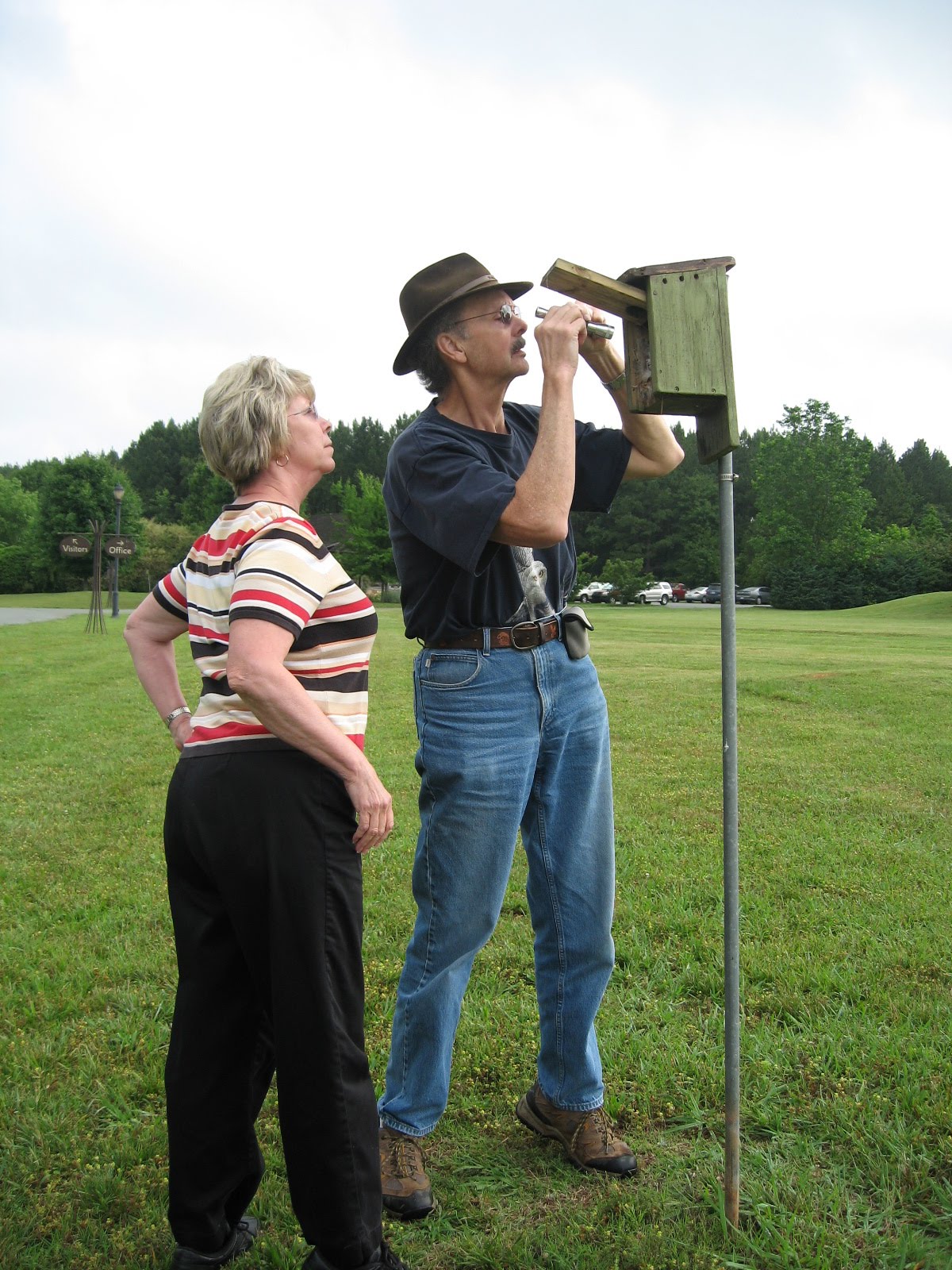
The biggest surprise has been a tree swallow that refuses to leave the box when we try to check on it. That mother bird is steadfast. She does not budge. We even used a flashlight in an effort to confirm her identity and all she did was show us her backside. Imagine that! Being 'mooned' by a bird! Tree swallows are known to use bluebird boxes and, in fact, sometimes are regarded as pests. However, this is the first year that one of our boxes has been used. Maybe in the next week or two, we'll be able to peek at what's going on inside that box. Mama has to leave sometime in order to gather insects for the chicks. If we're lucky, she'll be gone when we come along.

As to the "blues" themselves, everything is on course for this time of the season. Chicks have fledged and second nestings have begun. Life continues and it gives us many surprises along the way. That's the way it should be.

Sunday, May 16, 2010

Summer Garden Adventures for Kids

Gardens provide ideal settings for safe, active summer fun for kids, and the Daniel Stowe Botanical Garden is no exception. Garden Adventure Camp begins June 21st, offering half-day, week-long sessions through July 30th. The camps are designed to provide engaging, hands-on activities that will foster a love of plants, gardening, and the environment for children ages 4-12.

What will they do? Register your child for Garden Adventure Camp, and they'll spend their time at the Garden:
  1. Digging, planting, and watering plants in the Garden.
  2. Exploring the Woodland Trail.
  3. Catching insects in the meadow.
  4. Playing in the Willow Maze.
  5. Eating great snacks (that come from plants!) each day.
  6. Building a bamboo teepee or other fun garden projects.
  7. Solving a mystery in Nature Detective camp.
  8. Creating their own planters to take home.
  9. Discovering their favorite flower in a hike through the Garden, and then...
  10. Cooling off at the Tunnel Fountain.
  11. Riding the Garden Tram.
  12. Finding beneficial dragonflies and ladybugs in Critter Cavaliers Camp.
  13. Planting a plant of their own, and then checking and watering it each day.
  14. Creating nature art projects in Artists in the Garden camp.
  15. Tasting products made from tropical plants in the Orchid Conservatory.
  16. Discovering the tracks of Garden critters that enjoy the Garden at night.
  17. Observing garden life in action as pollinators go about their work.
  18. Experiencing the wonder of nature through plant-based adventures.
  19. Making new friends at the Garden.
  20. Cultivating a love of plants, gardening, and nature that will last a lifetime!

The list could go on, but you get the idea-- Garden Adventure Camp is a whole lot of fun! Specific activities in each session will vary depending on the theme, but all sessions are designed to include time outdoors exploring the Garden balanced with indoor projects, hands-on time to dig and plant and water, planters that kids create and take home, and healthy plant-based snacks. Garden Adventure Camp is ideal for parents looking to provide some structure for their child's (or grandchild's) summer and ensure that it's exciting and special. In addition to the regular sessions for ages 4-7 and 8-12, special one-day mini-camps are also available for younger 3-year-old campers who will attend with a parent or other caregiver. Your child will be so busy having fun that they won't even realize they're learning, thus keeping their minds engaged through informal science experiences that will resonate long after camp is over.

For more information about Garden Adventure Camp sessions, dates, and registration information, go to the Garden's website at www.dsbg.org. Discounts are offered for Garden members and for multiple session registrations. Questions? Call 704-829-1252 for more information or to register your child today. We'll see you-- and your child-- at Camp this summer.

Happy Gardening!

Cindy

Tuesday, May 11, 2010

Hello, Mom

Daniel Stowe Botanical welcomed more than 5,500 people to the Garden this weekend in what has become one of the most successful events of the year--Mother's Day Weekend.

Thanks to our partners, WSOC-TV Channel 9 and its Family Focus program and Rountree Plantation Garden Center, the Garden is able to create an unforgettable day for Moms and their families. With Channel 9's help we offer free admission to all Mothers and Rountree Plantation offered a free plant to each those Mothers lucky enough to get here early enough each day.

Something Classic, one of the Garden's preferred caterers offered picnic lunches in advance of the big weekend. Dr. Mitch Moser offered free mini-massages and Mary Kay Cosmetics Consultants were on hand with beauty tips for Mom.

Great planning by Garden staff paired with beautiful spring weather made for the creation of some fantastic Garden memories for the families that were here. And that' a lot of what a botanical garden is all about--creating memories with a connection to plants and nature.

If you haven't made it by the Garden this spring, and you want to see what we're talking about, you might want to make plans to come out soon. Our exhibit, "Come Sit A Spell," is now in it's second month. And connecting you to plants is what this exhibit is all about. In it, we hope you find inspiration for your garden, backyard deck or patio.
  

Thursday, April 29, 2010

Fresh Faces and the Evil Eye


With the end of April here, there are twenty-three bluebird chicks being fed and nourished by doting parents. Within the next week, ten of them probably will be out in the world learning the ways of chasing their own food. In addition there are forty-four eggs being incubated so the bluebird season is well on its way.


We have nests in seventeen of the thirty-three boxes. This is a slight increase over the number of nests last year at this time. Also, there are chickadee and titmouse nests in three of the boxes but we don’t include those in our data.

Unfortunately there is evidence of predators in the bluebird nests as some of the eggs have disappeared. The nests themselves don’t seem to be disturbed and we don’t find the eggs on the ground near the boxes so perhaps snakes are invading and eating them. Also, we are seeing the stick nests of house wrens in one box. The wren is persistent and we do remove them because, at this point, they are only the beginnings of nests and no eggs have been laid. If there are eggs or chicks in those nests, it is not lawful to remove them.

House sparrows have chosen one particular box for their use. They are a threat to the bluebird population so their nests are being removed also. House sparrows are not native birds and, therefore, not protected by law. They are messy birds and use lots of trash in their constructions. We’ve found materials such as cellophane, cigarette butts, and goose feathers. Like the house wrens, they will destroy bluebird eggs as well as chicks and sometimes prevent bluebird parents from entering the box.

As we peek into the nests, we are finding that the mother bird sometimes refuses to leave the box. We knock on the side of the box to make the bird fly out and when we open the panel to peek in, the bird is in there and just gives us the evil eye. When mama is glowering at us and refusing to budge, then we just tell her we’ll wait until next week to see what she’s hiding. Maybe her mood will be better then.

That’s the status of things along the bluebird trail here at the garden the last week of April.


Tuesday, April 20, 2010

Spring Cleaning in the Garden

Spring is here and now we are looking for those April showers that will bring May flowers and save us the trouble of watering our plants. There are a few clouds this afternoon, maybe we'll get lucky. If you have irrigation it is a good idea to test the system for leaks, adjust the heads so they are not watering the sidewalk, and check the run time so it does not allow runoff. Water conservation is everyone's responsibility.
Here at Daniel Stowe we are cleaning up, pruning back and enjoying the cool weather and colorful garden while we work. It is important to get ahead of those late winter/early spring weeds. Henbit and chickweed are the most common and pulling them before they have a chance to set seed will save time later. Prune spring flowering shrubs as soon as they are done blooming, this includes forsythia, spirea, quince, cherrylaurel and azaleas. Now that leaves are out we can remove any winter damaged branches and cut back the fig tree by one third. If you have naturalized daffodils it is important to leave the foliage alone (no knot tying) until it turns brown. These leaves are feeding next year's bulb. If they are trying to produce seed it is OK to trim off the very tip so energy is not wasted on seed production.
Finally, there is a fragrant flowering, silver leaved shrub in bloom in the woods right now that merits our attention. This is Russian-olive (Elaeagnus angustifolia) also known as Silver Berry and Wild Olive. While it has long been cultivated in Europe and sometimes used along highways here (as is it's cousin Autumn Olive) we should be on our guard.It has invaded the piedmont woodlands and is as thick as privet in many locations. Make it's removal part of your spring cleaning in the garden this year.